


What Screw Do I Need? Ultimate Screw Buying Guide
Published 22nd Jan 2026

Our screw buying guide tells you which screw you’ll need for which job without the jargon. See below for our quick answers and keep reading to learn why you need a different screw driver bit for different jobs.
Quick answers – pick these screws for these jobs
Woodwork (indoor): Use wood screws (zinc-plated or stainless steel for moisture-prone areas). Use a countersunk head for a flush finish.
Outdoor decking: Use stainless-steel decking screws or coated exterior screws with deep threads and a self-countersinking head.
Masonry (brick, block, mortar): Use concrete screws (or use wall-plugs with double-thread screws). Pre-drill with a masonry bit.
Electronics/metal panels: Use machine screws with matching nuts or tapped holes.
Flooring: Use flooring screws (Torx or Pozidriv) for high torque and minimal cam-out.
Keep reading for why the right screw drive bit, coating and thread matter for each job.
What are the different parts of a screw?
Understanding screw anatomy makes choosing easier:
Head: The visible top of the screw (countersunk, round, pan, hex, etc.).
Drive: The shape recessed into the head that takes the screwdriver bit (Phillips, Pozidriv, Torx, square, slotted, hex).
Shank: The smooth portion under the head on some screws.
Thread: The spiralled ridge that bites into the material. Threads can be coarse or fine, single or double.
Point: The tip (sharp for wood, blunt for machine screws). Some have self-drilling tips.
Length: Measured from under the head to the tip on countersunk screws; overall length on other head types.
Diameter (gauge): Thicker screws have greater holding power.
Coating/finish: Zinc-plated, galvanised, black phosphate, or stainless steel for corrosion resistance.
Which types of screws are there?
Wood screws
- Use for softwood, hardwood, MDF, chipboard and general joinery.
- Features coarse threads near the tip and a partially smooth shank under the head, which helps pull two pieces tightly together.
- Common head types include countersunk (flat-head) for a flush finish, and round or pan heads for visible fixings.
- Available with Phillips, Pozidriv, square or Torx drives, depending on preference.
Stainless-steel screws
- Used outdoors or wherever corrosion resistance is required, such as garden furniture, exterior joinery and marine applications.
- Made from a corrosion-resistant alloy and typically more expensive, but essential in damp or coastal conditions.
- Use 304 grade for general outdoor use and 316 grade for coastal or marine environments.
Decking screws
- As you can imagine, designed for attaching decking boards to joists.
- They are usually specially coated or made from stainless steel, with deeper threads to grip decking planks securely. Many have self-countersinking heads and square or Torx drives to reduce splitting.
- Always use screws designed specifically for decking rather than standard wood screws to prevent rust staining and premature failure.
Double-thread (twin-thread) screws
- Used with wall-plugs for masonry fixings and in applications where fast pull-in is required.
- They feature two sets of threads that pull materials together more quickly and reduce splitting in thinner materials.
Concrete screws
- Used for direct fixing into brick, concrete and block for light to medium loads.
- Manufactured from hardened steel with threads designed to cut into masonry. A correctly sized pilot hole is required.
- For heavy loads, anchors or chemical fixings should be used instead.
Machine screws
- Used for metal-to-metal fixing, electronics, machinery and vehicles.
- They have uniform threads along the entire shank and are used with nuts or in threaded or tapped holes.
- Common drive types include slotted, Phillips, hex (Allen) and Torx.
Flooring screws
- Used for installing floorboards and subfloor fixings.
- They often have a small head for concealment and a Torx or Pozidriv drive, allowing high torque without damaging the screw.
Brass screws
- Used for decorative fixings, light joinery and cabinet hardware where a golden finish is desired.
- Brass is a softer metal, so these screws are not suitable for heavy loads or structural applications.
Electrical screws
- Used for fixing electrical fittings, switch plates and connectors.
- They are usually smaller and may have slotted or Pozidriv heads. Always use rated screws for electrical boxes and earthing where required.
What are the different screw drive types?
The drive type of a screw helps you know what type of screwdriver you’ll need to install it. Matching the drive type to the job reduces slipping and speeds up installation. Below we explain the different head types that match up with different screwdrivers.
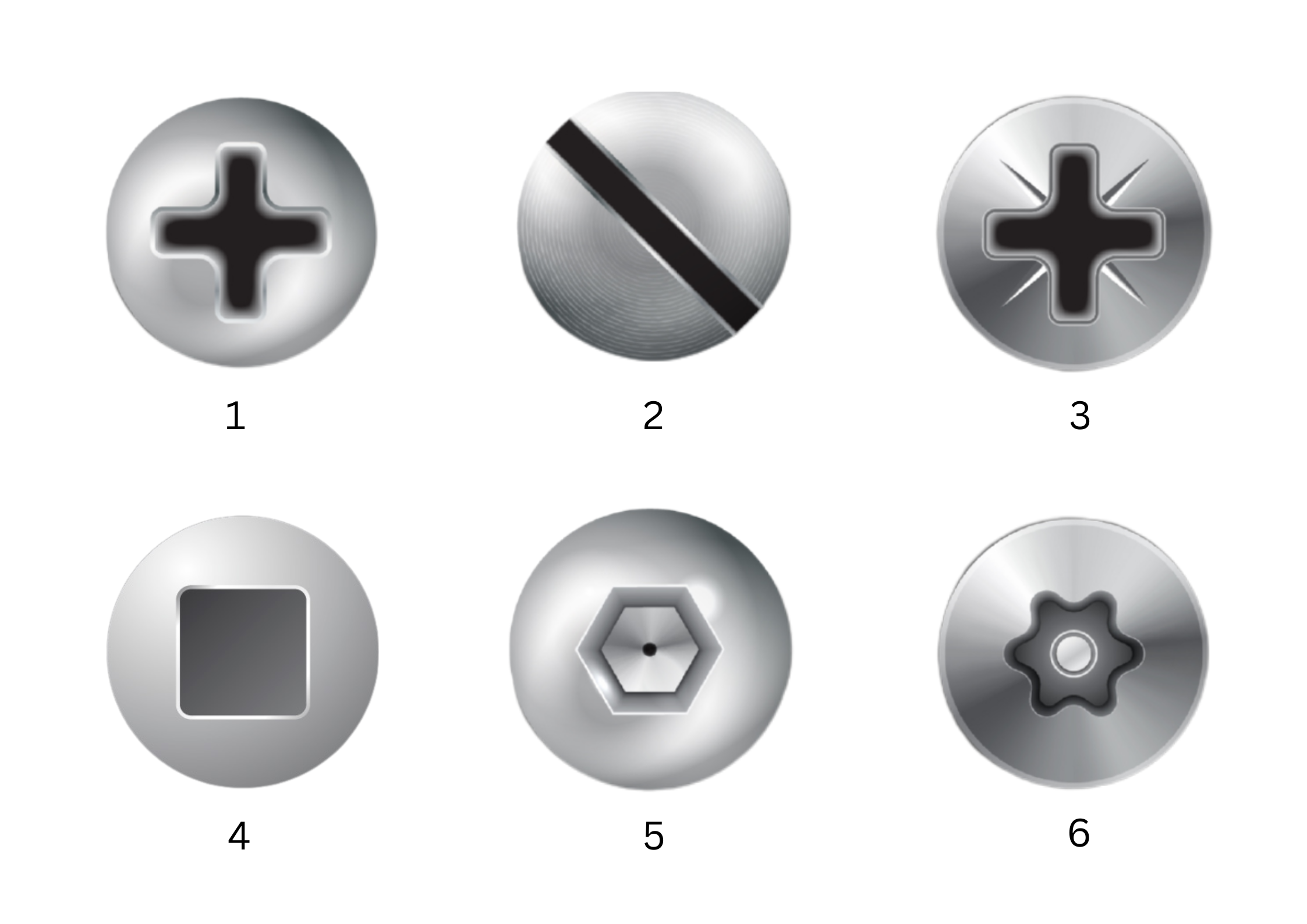
1. Phillips
- A cross-shaped recess commonly found on general-purpose screws.
- Easy to find bits and self-centring, but designed to cam out under high torque, making it less suitable for modern high-torque drivers.
2. Slotted (flat)
- A single straight groove.
- Simple and common on decorative or vintage fittings, but easy to slip and unsuitable for power tools or high-torque applications.
3. Pozidriv
- Similar to Phillips but with additional contact points for better torque transfer.
- Offers less cam-out than Phillips and is common in the UK and Europe.
- Requires Pozidriv bits, as Phillips bits will not fit correctly.
4. Square (Robertson)
- A square recess that provides excellent bit engagement.
- Very low cam-out, quick to drive and popular for flooring and cabinetry.
- Less common in some regions and requires a square bit.
5. Hex (Allen)
- A hexagonal recess used with Allen keys or hex bits.
- Provides good torque and is common on machine screws and flat-pack furniture.
- The recess can be stripped if the wrong size key is used.
6. Torx
- A six-point star-shaped recess.
- Excellent torque transfer with very low cam-out, making it ideal for power drivers and flooring screws.
- Requires the correct Torx bit size and is more specialist than Phillips.
Security drives
- Tamper-resistant versions of Phillips, Torx and other drives, such as Torx with a centre pin.
- Used for public fittings, locks and electronics where unauthorised removal should be discouraged.
How to choose the right screw: a checklist
- The material you are fixing into, such as wood, masonry, metal or plasterboard.
- Load and safety requirements, including whether the fixing is structural or cosmetic.
- The environment, for example indoors, outdoors or coastal locations.
- The required head style, such as countersunk for a flush finish or pan or round heads for visible fixings.
- The drive type you already have bits for, with Torx offering high torque and Pozidriv being common in the UK.
- Whether pre-drilling or pilot holes are required, particularly for masonry and hardwoods.
- The level of corrosion resistance needed, with stainless-steel or coated screws recommended for outdoor use.
Frequently asked questions
What screw should I use for plasterboard?
Use plasterboard screws with a thin, sharp thread, often finished in black phosphate, for fixing plasterboard to timber or metal studs. For heavy items, use suitable wall anchors or toggle fixings.
Can I use wood screws for metal?
No. Wood screws are designed specifically for timber. For metal-to-metal fixings, use machine screws or self-tapping metal screws.
What is the difference between stainless-steel and galvanised screws?
Stainless-steel is an alloy that resists corrosion naturally, while galvanised screws are steel coated with zinc. Stainless-steel is generally better suited to coastal or high-moisture environments.
Do decking screws need pre-drilling?
Pre-drilling is usually unnecessary for softwoods, but it is recommended for hardwoods. Always follow the manufacturer’s guidance.
What size drill bit should I use for masonry screws?
Use the masonry drill bit size recommended by the screw manufacturer. Typically, the pilot hole is close to the screw’s core diameter.
Can I mix different metals, such as brass screws with stainless-steel fittings?
Mixing metals can cause galvanic corrosion when exposed to moisture. Where possible, match metals or use stainless-steel to avoid long-term issues.